
The Neuroscience of Speech: Comparing Parkinson’s Disease and Developmental Stuttering
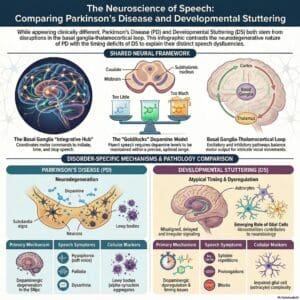 A recent review published in the European Journal of Neuroscience highlights important similarities and critical differences between Parkinson’s Disease (PD) and Developmental Stuttering (DS), two distinct conditions that affect speech motor control.
The review examines how both disorders involve disruptions in basal ganglia circuits and dopaminergic pathways — brain systems essential for motor timing and speech fluency. Emerging evidence also suggests overlapping contributions from neuroinflammation, autoimmune processes, and cellular energy regulation.
Despite these shared network-level disruptions, the underlying cellular mechanisms differ significantly.
Parkinson’s Disease is characterized by progressive degeneration of dopamine-producing neurons, leading to symptoms such as hypophonia (reduced speech volume), monotone speech, and whole-word repetition (palilalia).
In contrast, Developmental Stuttering does not involve neurodegeneration. Instead, research suggests early atypical brain connectivity and structural differences in astrocytes and microglia — key support cells in the brain. Speech symptoms in DS typically involve repetition or prolongation of initial syllables without reduced vocal intensity.
Understanding these distinctions is critical for the development of targeted, mechanism-based therapeutic approaches.
Read the full article here.
Reference:
Turk AZ, Millwater M, Sheikh-Bahaei S, Mollaei F, Riessland M, SheikhBahaei S. Speech Motor Deficits in Developmental Stuttering and Parkinson’s Disease: From Cellular and Circuit to Network-Level Disruptions. Eur J Neurosci. 2026 Feb;63(3):e70393.