Social Anxiety and the Hidden Impact of Stuttering
 Our latest Open Access publication in Medical Research Archives, “Utility of the Liebowitz Social Anxiety Scale in Understanding Stuttering Issues,” examines the often unseen burden of stuttering in adults.
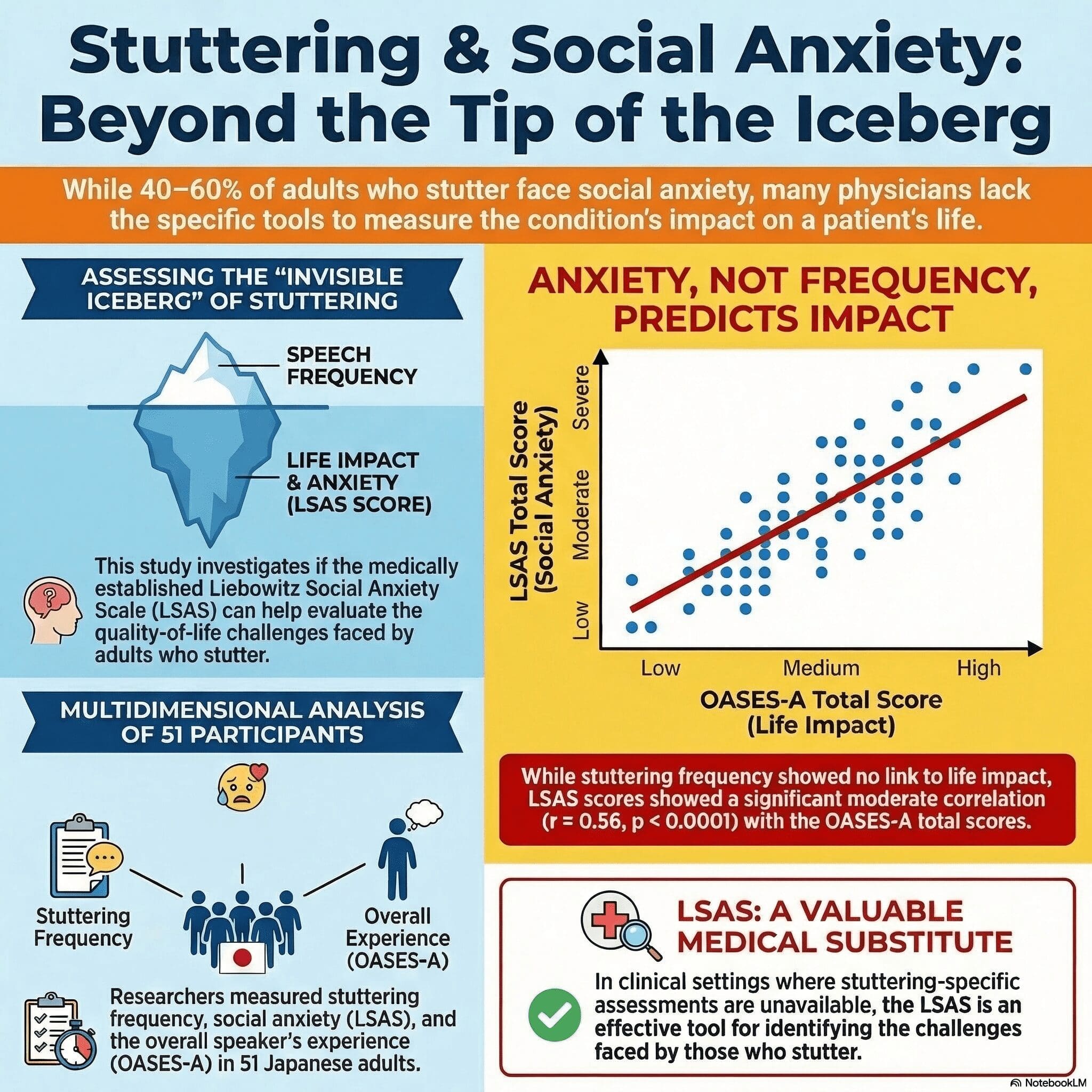
Stuttering is often described as an “iceberg,” where the visible speech disruption is only one part of a much broader experience. For many adults who stutter, the greater burden may lie in the hidden effects on daily life, confidence, and mental health. In this study, our team examined the relationship between stuttering frequency, overall life impact, and social anxiety in 51 Japanese adults who stutter.
Our findings showed that stuttering frequency was not significantly associated with either social anxiety severity or the overall negative impact of stuttering on daily life. In other words, a person who stutters less often may still experience substantial fear, restriction, and distress. We also found a significant moderate correlation between overall life impact and social anxiety, suggesting that social anxiety may be an important indicator of the broader challenges faced by adults who stutter.
These results highlight the value of the Liebowitz Social Anxiety Scale (LSAS) as a practical clinical tool. Because the LSAS is already familiar to many healthcare professionals, it may serve as a useful substitute when stuttering-specific assessments such as the OASES-A are not available. This can help physicians and other clinicians better identify hidden difficulties, monitor treatment outcomes, and connect patients to effective support, including cognitive-behavioral therapy and pharmacological treatment when appropriate.
Read the full article here.
Reference
Kikuchi Y, Maguire GA, Murakami D, Yamaguchi Y, Nakagawa T, Umezaki T. Utility of the Liebowitz Social Anxiety Scale in Understanding Stuttering Issues. Medical Research Archives. 2024;12(11). doi: 10.18103/mra.v12i11.5898.
 English
  Spanish
  Portuguese
  Japanese